
Key Takeaways
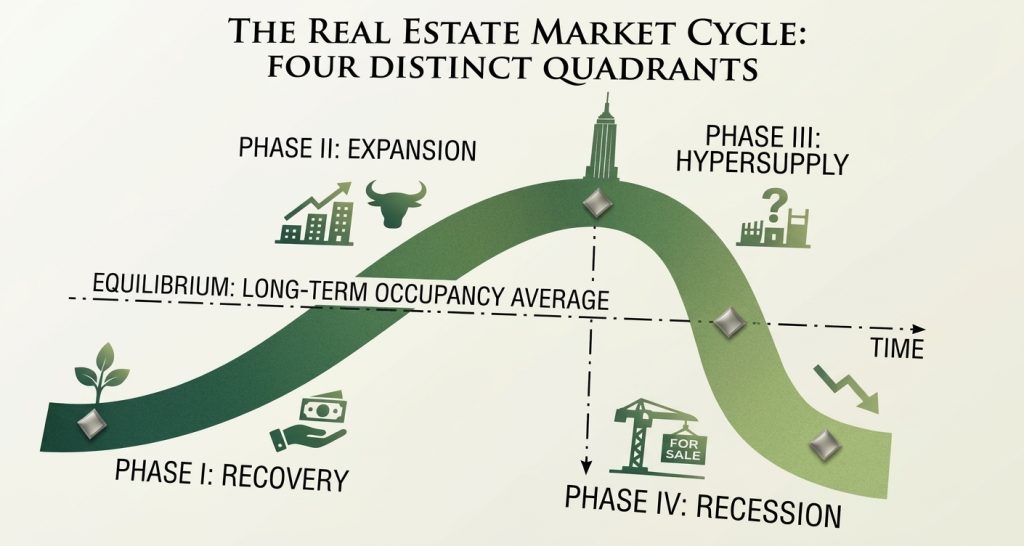
- A real estate market cycle moves through four phases: recovery, expansion, hypersupply, and recession.
- Interest rates, jobs, population trends, and policy push markets from one phase to the next.
- Cycles are local, so your city may differ from the national picture.
- The 18-year pattern is a rough guide, not a calendar.
- Buyers, sellers, and investors need different moves in each phase.
Real estate cycles are the repeating pattern of recovery, expansion, hypersupply, and recession that property markets move through, driven by supply, demand, and the economy.
Anyone who has bought or sold property for a while has seen it: prices climb, listings vanish within days, then one season the signs sit for months and sellers start cutting. That swing isn’t random. Real estate cycles are the rhythm behind it, and this real estate cycle explained guide walks through each stage in plain terms. Think of the real estate market cycle as a tide, not a trend line. You can’t stop it, but you can learn to read it before committing your money.
Why Do Real Estate Cycles Matter?
Cycles shape the price you pay, the rent you collect, and how long a property sits before it sells. A buyer who understands the real estate market cycle can tell a bargain from a falling knife. A seller can decide whether to list now or wait. An investor can plan financing, renovation budgets, and exit timing with fewer surprises.
Ignoring the cycle usually costs money in one of two ways: overpaying near the peak out of fear of missing out, or sitting on cash near the bottom because every headline sounds grim.
4 Phases Of The Real Estate Cycle
The model most often cited comes from academic real estate finance. The cycle is circular, so recovery follows recession and the loop restarts. Here’s how each stage tends to look.
Phase I: Recovery
Recovery starts at the bottom. Vacancy is still high, prices are flat or soft, and almost nobody is building. Sentiment is gloomy, which is exactly why this phase quietly rewards patient buyers. Transactions are slow, sellers are more flexible, and cash buyers hold a real edge. Rents stop falling first, then occupancy inches up. Lenders stay cautious, so financing can be harder to get even as values stabilize. The risk is paying too early and waiting longer than expected for appreciation.
Phase II: Expansion
Expansion is the stretch most people picture when they think of a healthy market. Demand outpaces supply, vacancy falls, rents rise, and builders return with new projects. Prices move up steadily, and multiple-offer situations become common. For owners, this is the comfortable phase: equity grows and refinancing is easy. For newcomers, it gets harder each month, because competition rises faster than inventory. Late in expansion, the quality of deals tends to slip as buyers stretch on price and underwriting gets looser. That looseness is often the first sign the cycle is maturing.
Phase III: Hypersupply
Hypersupply is where optimism outruns reality. Projects that were started during the good years finish all at once, and supply overshoots demand. Vacancy climbs, listings sit longer, and sellers begin offering concessions such as free rent or closing-cost credits. Prices usually stall before they fall, which fools people into thinking it’s a pause. Highly leveraged owners feel it first, since softer rents squeeze their payments. This is the phase where underwriting that assumed endless growth gets exposed, so conservative numbers matter more than ever.
Phase IV: Recession
Recession brings falling prices, rising vacancy, and a surge of distressed sales. Credit tightens, buyers disappear, and owners who can’t refinance may be forced to sell. The 2008 housing crash is the textbook example, with foreclosures reshaping entire neighborhoods. Not every recession is that severe, though. Some are mild corrections that last a couple of years. Cash-rich buyers and prepared investors find motivated sellers, short sales, and foreclosures, but they also face more uncertainty about where the floor is. Eventually prices stop dropping, new construction is almost nonexistent, and the market sets up for the next recovery.
What Causes Real Estate Cycles to Rise and Fall?
No single force drives the cycle. Several work together.
Interest Rates and Credit
Mortgage rates set the monthly cost of owning. When borrowing gets expensive, fewer buyers qualify and prices lose momentum.
Jobs, Population, and Income
Markets follow people. Cities that add jobs and residents tend to see demand outrun supply, while places losing population often struggle.
Supply, Policy, and Sentiment
Building takes years, so supply reacts late and overshoots. Tax rules, zoning, and incentives can speed or slow that, and fear or excitement amplifies every turn.
How to Tell Which Phase the Market Is In Right Now
You won’t get a clean answer from one number, but a handful of local indicators paint a clear picture.
Indicators to Watch
Look at inventory levels, median days on market, the share of listings with price cuts, rent and vacancy trends, and the number of new building permits. Rising inventory and longer days on market point toward hypersupply. Shrinking inventory with fast sales suggests expansion, a classic seller’s market.
Use Local Data, Not Headlines
Your county’s numbers matter more than national averages. Local Realtor associations, county records, and public data sources are good starting points. Update your read every quarter.
What to Do in Each Phase: Buyers, Sellers, and Investors
For Buyers
Recovery and early recession reward patience and cash reserves. In late expansion, avoid stretching your budget to win a bidding war.
For Sellers
Expansion is your window, so price realistically and list while demand is strong. In hypersupply, sharpen your price early rather than chasing the market down.
For Investors
Buy for cash flow, not just appreciation, and keep reserves for vacancies. Late in the cycle, favor fixed-rate financing and conservative underwriting. In recession, distressed deals open up for those with capital and a plan.
Final Thoughts on Real Estate Cycles
Real estate cycles will keep turning, and no one times them perfectly. The investors who do well tend to stay informed, keep reserves, and adjust their strategy to the phase in front of them rather than the one they wish they were in.
Dwanderful (dwanderful.com) is a real estate investing resource created by real estate investor and podcast host Dwan Bent-Twyford. Since understanding financing is an important part of investing, Dwan offers resources to help investors build their knowledge and make more informed decisions.
Her free Real Estate Lingo book explains essential real estate terms, while Five Pillars of Real Estate Investing provides practical knowledge and strategies for building a strong investing foundation. For investors interested in distressed properties, LEVEL 1: Complete Foreclosure Investors’ Choice Program teaches foreclosure investing strategies, while Foreclosure Fortunes helps investors identify foreclosure opportunities and avoid common pitfalls. The Fed Up Program focuses on helping homeowners in financial distress while creating opportunities for investors.
Dwan also offers How to Sell a House When It’s Worth Less Than the Mortgage, covering options such as short sales and subject-to strategies, and Short-Sale Pre-Foreclosure Investing, which explores buying properties through short-sale and pre-foreclosure opportunities.
If you’re still deciding on your next investment move, Dwanderful’s quiz game takes less than a minute and helps you discover how you could potentially generate six figures in the next six months, whether you’re buying your first property or your next.

Frequently Asked Questions
How does the real estate cycle impact different asset classes?
Residential, office, retail, industrial, and multifamily properties each run on their own timelines. Apartments tend to hold up better in downturns, while office space can lag. Check the cycle for your specific property type.
How do macroeconomic factors influence the real estate cycle?
Interest rates, inflation, employment, and credit availability set how much people can afford and how much developers will build. When rates rise or jobs weaken, demand tends to cool, and the cycle can turn.
What real estate cycle are we in now?
There’s no single answer, because cycles are local. Since 2022, higher mortgage rates have cooled many markets that surged earlier, while others kept growing. Check current inventory, price trends, and days on market in your own city.
Will the 18-year property cycle end in 2026?
The 18-year theory, often credited to Homer Hoyt and later popularized by Fred Harrison, has pointed to the mid-2020s as a possible peak. It’s a historical pattern, not a schedule. Rates, policy, and supply can all shift the timing, so treat it as context rather than a forecast.

Editorial Review by Dwan,
Real Estate Investor & Podcast Host
Dwan is America’s Most Sought After Real Estate Investor™ and The Queen of Short Sales™. She went from a single mom with no resources to building a successful real estate business through wholesaling, rehabbing, rentals, and commercial properties. Today, she teaches investors how to succeed without costly mistakes through her books, podcast, and training programs.
Learn More