


Key Takeaways
- Conveyancing searches are enquiries into a property’s legal, planning, environmental and drainage records, made before you exchange contracts.
- The three core searches are the local authority search, the drainage and water search, and the environmental search.
- Some properties need extras, such as mining or chancel repair searches, depending on where they are.
- Mortgage lenders almost always require searches, and cash buyers should still order them.
- A standard package often costs roughly £250 to £500 and can take one to four weeks to come back.
- A problem is not always a deal-breaker, but it gives you room to renegotiate, fix the issue or walk away.
Conveyancing searches are legal checks made during a property purchase to uncover issues with planning, drainage, environment, and local authority records before you commit.
Buying a home is exciting, and it is easy to focus on the kitchen or the garden. What the house sits on, what is planned next door, and where the wastewater goes matter just as much. If you are asking what are conveyancing searches, they are the enquiries your conveyancer sends to public bodies and specialist providers to confirm that nothing hidden could affect your purchase. This guide covers what they check, what they cost, and what to do when one raises a concern.
What Are Conveyancing Searches and Why Are They Important?
A Simple Definition
Conveyancing searches are official enquiries made during the legal process of buying property. Your conveyancer contacts the local council, the water company and other record holders, and each returns a report about the property and its surroundings.
Why They Matter
The seller’s paperwork only tells part of the story. A search might show that the road outside is not adopted by the council, meaning residents share the repair bill. It might reveal that a large land development has been approved on the land behind the garden. Finding this out before exchange of contracts costs a few hundred pounds. Finding it out afterwards can cost far more.
What Are the Main Types of Conveyancing Searches?
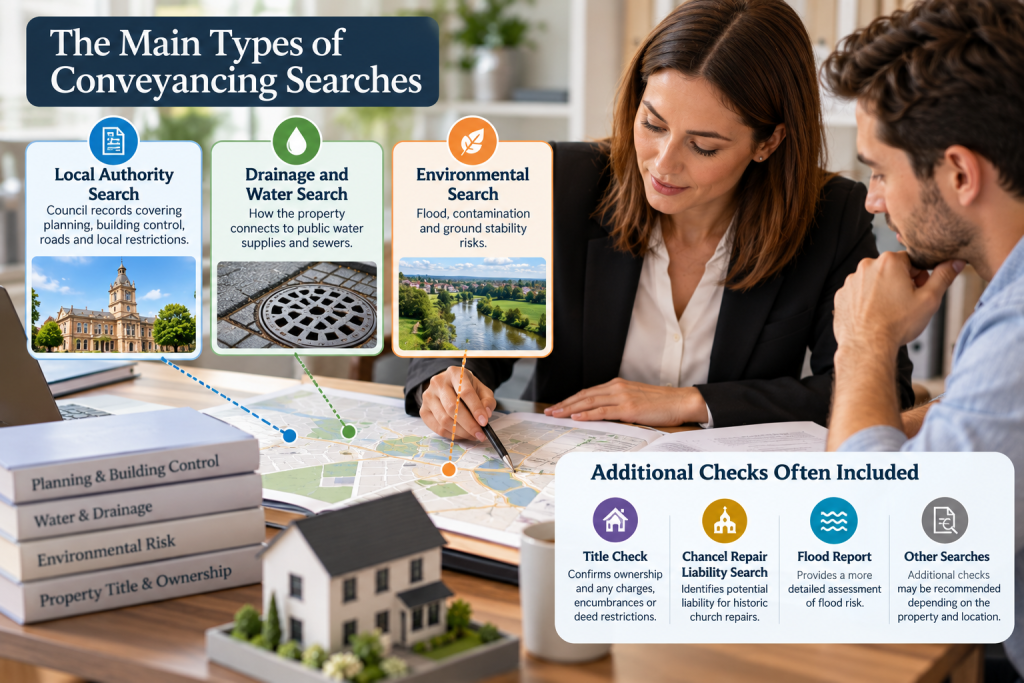
The Three Core Searches
- Local authority search: council records covering planning, building control, roads and local restrictions.
- Drainage and water search: how the property connects to public water supplies and sewers.
- Environmental search: flood, contamination and ground stability risks.
Checks Often Added Alongside Them
Most conveyancers also run a title check at HM Land Registry, which confirms who legally owns the property and whether any charges, encumbrances or deed restrictions are registered. A chancel repair liability search is another common addition, and some firms include a standalone flood report as well.
What Does Each Conveyancing Search Check?
Local Authority Search
This is usually the most detailed. It shows planning permissions and enforcement notices, whether building regulation sign-off exists for past extensions, and whether the road is maintained by the council. It also flags conservation area status, listed building status, tree preservation orders and nearby proposals such as new roads. For example, a loft conversion without sign-off can become your responsibility to put right once you own the house.
Drainage and Water Search
This confirms whether the property is connected to mains water and public sewers, who maintains the pipes, and whether a public sewer runs beneath the garden. That last point matters because building over or close to a sewer usually needs the water company’s permission, which could limit future extensions.
Environmental Search
This assesses flood risk from rivers, surface water and the sea, along with past industrial use, landfill and ground stability. A home built on former industrial land, for instance, may prompt further investigation and can affect how easily you get insurance.
Are Additional Conveyancing Searches Needed for Some Properties?
Location-Based Extras
Yes, depending on where the property is. In former coal areas, a Coal Authority mining report is standard. Parts of Cornwall and Devon call for a tin mining report, and Cheshire has its own brine subsidence search. Other regions may need reports on limestone or chalk workings.
Situation-Based Extras
Rural homes may need commons registration or highway searches, and properties near major infrastructure projects can need specific checks. A leasehold property also needs its lease reviewed, since the remaining term and ground rent affect value. If the boundary looks unclear on site, a boundary survey may help, and you can learn how to find your property line yourself. Your conveyancer will recommend extras based on the address.
Are Conveyancing Searches Required and Who Pays for Them?
Are They Legally Required?
No law forces you to order them, but a mortgage lender almost always will, alongside its own mortgage valuation, to protect its security over the property. Cash buyers can skip them, though that means taking on any hidden risk personally, which is rarely wise.
Who Pays for Them?
The buyer normally pays. The fees appear on your conveyancer’s estimate as disbursements, meaning costs passed on from third parties. Sellers do not usually cover them.

How Much Do Conveyancing Searches Cost and How Long Do They Take?
Typical Costs
Prices vary by council and provider, so check your conveyancer’s estimate. A standard package often falls between £250 and £500. The local authority search is the biggest item and can range from roughly £100 to over £400 depending on the council. Drainage and environmental reports are usually £40 to £80 each, and extra searches add to the total.
Turnaround Times
Some councils return results within days, while others take two to four weeks or longer. Ordering as soon as your offer is accepted keeps the sale on schedule. Results are generally treated as valid for around six months by lenders, so a long delay may mean repeating them.
What Happens If a Conveyancing Search Finds a Problem?
Common Outcomes
Your conveyancer will explain the finding and how serious it is. Options usually include asking the seller to fix common title issues or supply missing documents, arranging indemnity insurance for matters such as absent approvals, renegotiating the price, or withdrawing before exchange.
Acting Quickly
Do not sit on unwelcome results. Contracts are not binding until exchange, so this is your window to act.
Get Expert Help With Your Conveyancing Searches
Dwanderful is a real estate investing resource created by real estate investor and podcast host Dwan Bent-Twyford. Since understanding financing is an important part of investing, Dwan offers resources to help investors build their knowledge and make more informed decisions.
Her free Real Estate Lingo book explains essential real estate terms, while Five Pillars of Real Estate Investing provides practical knowledge and strategies for building a strong investing foundation. For investors interested in distressed properties, LEVEL 1: Complete Foreclosure Investors’ Choice Program teaches foreclosure investing strategies, while Foreclosure Fortunes helps investors identify foreclosure opportunities and avoid common pitfalls. The Fed Up Program focuses on helping homeowners in financial distress while creating opportunities for investors.
Dwan also offers How to Sell a House When It’s Worth Less Than the Mortgage, covering options such as short sales and subject-to strategies, and Short-Sale Pre-Foreclosure Investing, which explores buying properties through short-sale and pre-foreclosure opportunities.
If you’re still deciding on your next investment move, Dwanderful’s quiz game takes less than a minute and helps you discover how you could potentially generate six figures in the next six months, whether you’re buying your first property or your next. Contact us now!

Frequently Asked Questions
Can I choose which conveyancing searches are carried out on my property?
Partly. Your conveyancer recommends a package based on the property and your lender’s requirements, and you can add extras. Skipping standard searches is risky and may breach your mortgage conditions.
What happens if my property is in an area with a history of mining?
A coal or tin mining report identifies past workings and any risk of subsidence. Not every mined area is a problem, but the report shows whether further surveys or insurance are needed.
Will conveyancing searches tell me if a property has planning permission?
The local authority search lists planning permissions and enforcement notices on record. It may not show whether every alteration was approved, so your conveyancer will compare the results with what you noticed while touring the house.
Do conveyancing searches reveal problems inside the house?
No. Searches examine records and surroundings, not the building’s condition. For damp, structural or wiring concerns, arrange a RICS survey or a building condition assessment, and prepare for the home inspection properly.
What should I ask my conveyancer if my search results concern me?
Ask what the finding means in practice, how likely it is to affect value or insurance, what fixes or indemnity options exist, and how it could change your timeline. These questions to ask before buying a house make a useful companion checklist.

Editorial Review by Dwan,
Real Estate Investor & Podcast Host
Dwan is America’s Most Sought After Real Estate Investor™ and The Queen of Short Sales™. She went from a single mom with no resources to building a successful real estate business through wholesaling, rehabbing, rentals, and commercial properties. Today, she teaches investors how to succeed without costly mistakes through her books, podcast, and training programs.
Learn More