


Key Takeaways
- Commercial real estate generates returns through rental income and appreciation.
- Common strategies include buy-and-hold, value-add, triple net leases, and syndications.
- Profitability depends on cap rate, cash-on-cash return, and net operating income.
- Increasing income or reducing expenses directly raises a property’s value.
- Reducing risk starts with due diligence, conservative underwriting, and diversified tenants.
Investors make money from commercial real estate through rental income, property appreciation, and value-add improvements, with returns driven by strong tenants, location, and smart financing.
Commercial real estate has a reputation for being a wealth-building tool reserved for institutional investors, but that’s not the full picture. Individual investors buy strip malls, office buildings, and warehouses every day, many with far less capital than you’d expect. If you’re wondering how to make money from commercial property, the short answer comes down to a handful of repeatable strategies: collecting rent, increasing a property’s value, and eventually selling or refinancing to capture that gain.
This guide walks through how commercial real estate generates income, the strategies experienced investors rely on, and the metrics and habits that separate a profitable deal from a costly mistake.
Understanding Commercial Real Estate
Commercial real estate refers to property used for business purposes rather than as a personal residence, including office buildings, retail centers, warehouses, multifamily complexes with five or more units, and specialty properties like self-storage.
Why Commercial Differs From Residential
The biggest difference isn’t size, it’s valuation. Residential homes are typically valued on comparable sales nearby. Commercial properties are valued largely on the income they generate, meaning an investor can directly influence a property’s value by improving its performance, something much harder to do with a single-family rental.

How Does Commercial Real Estate Make Money?
At its core, commercial real estate produces returns in two ways: cash flow while you own it, and appreciation when you sell or refinance.
Rental Income
Tenants pay rent, and after covering taxes, insurance, maintenance, and debt service, whatever remains is cash flow. In triple net (NNN) leases, tenants cover taxes, insurance, and maintenance directly, reducing the landlord’s burden and creating more predictable income.
Appreciation
As NOI grows, market value typically grows with it, through rising rents, lower vacancy, or improvements that let you charge more per square foot. Broader market appreciation helps too, but relying on that alone is far less controllable than improving the property itself.
What Are the Best Strategies for Making Money With Commercial Real Estate?
Different approaches suit different capital levels, risk tolerances, and time commitments.
Buy-and-Hold and Triple Net Leasing
The most straightforward approach is purchasing a stabilized property with existing tenants and collecting rental income while it appreciates, popular with investors who want steady, passive income. NNN properties leased to established tenants, think a freestanding pharmacy, shift most expenses onto the tenant, lowering both returns and management burden.
Value-Add Investing
Value-add investors buy underperforming properties, ones with below-market rents, high vacancy, or deferred maintenance, and improve them through renovation, re-leasing, or stronger tenants. Because value is tied to income, even modest improvements can produce outsized returns.
Syndications and Funds
For investors who don’t want to buy an entire property themselves, syndications pool capital from multiple investors to purchase larger assets, lowering the barrier to entry, though it means giving up direct control.

How Do You Identify a Profitable Commercial Real Estate Investment?
Finding a good deal starts long before you make an offer.
Start With Location, Demand, and Tenants
A property’s income potential is only as strong as demand for space in that area, so look at local employment trends and population growth. For properties with existing tenants, review lease terms and creditworthiness: a property that’s 90% leased to one struggling business is riskier than it looks on paper.
Run the Numbers First
It’s easy to get excited about a building’s potential and skip past the math. Calculate what the property needs to earn to justify the price, and compare that honestly to its realistic future performance.
Which Commercial Real Estate Metrics Should You Analyze?
Numbers tell you far more than curb appeal ever will.
Net Operating Income (NOI)
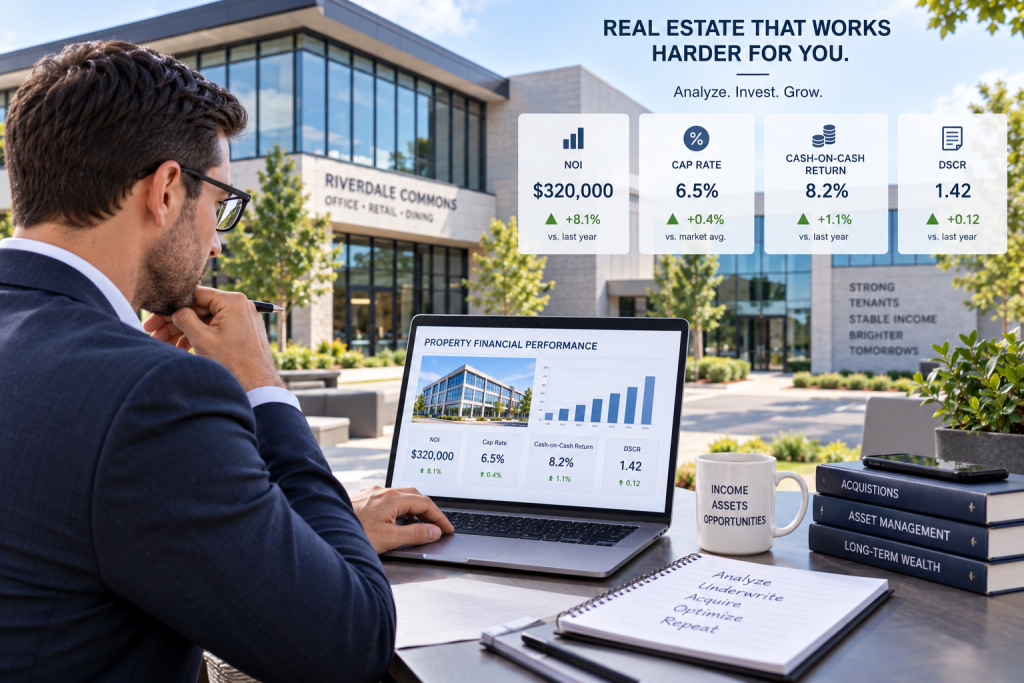
NOI is total income minus operating expenses, excluding debt payments. It’s the foundation almost every other commercial metric is built on.
Cap Rate and Cash-on-Cash Return
The capitalization rate is NOI divided by the property’s price, a quick way to compare returns across properties, though it ignores financing. Cash-on-cash return measures actual cash income relative to cash invested, factoring in financing, and is often more useful for leveraged investors since it reflects real out-of-pocket return.
Debt Service Coverage Ratio (DSCR)
Lenders rely on DSCR, comparing NOI to debt payments, to confirm a property generates enough income to cover its loan. A DSCR below 1.0 is a major red flag.
How Can You Increase the Value of a Commercial Property?
Because commercial value is tied directly to income, increasing value usually means increasing NOI.
Raise Rents and Reduce Expenses
If existing leases are below market, renewing or re-leasing at current rates can increase income, balanced against tenant retention risk. On the other side, renegotiating service contracts, improving energy efficiency, or addressing deferred maintenance early can improve NOI without touching rent at all.
Improve the Physical Property
Updated common areas, better signage, or modernized units justify higher rents and attract stronger tenants, compounding into higher income and a more marketable property at sale.
How Can You Reduce Risk and Maximize Commercial Real Estate Returns?
Every investment carries risk, but disciplined investors manage it rather than avoid it entirely.
Diversify and Underwrite Conservatively
Properties with multiple tenants across different industries are generally more resilient than single-tenant buildings. Avoid basing projections on best-case scenarios; build in vacancy allowances, rising expenses, and interest rate buffers so the deal still works if conditions shift.
Do Thorough Due Diligence
Review leases, inspect the property, verify zoning, and understand the local market before closing. Skipping this to move faster is one of the most common ways investors lose money.
Make Your Commercial Real Estate Investment Work for You
Making money from commercial real estate isn’t about finding one perfect deal, it’s about understanding how income, value, and risk connect, and applying that knowledge consistently. Whether you’re drawn to steady cash flow or hands-on value-add projects, the fundamentals stay the same: know your numbers, understand your market, and never skip due diligence.
Dwanderful is a real estate investing resource created by real estate investor and podcast host Dwan Bent-Twyford. Since understanding financing is an important part of investing, Dwan offers resources to help investors build their knowledge and make more informed decisions.
Her free Real Estate Lingo book explains essential real estate terms, while Five Pillars of Real Estate Investing provides practical knowledge and strategies for building a strong investing foundation. For investors interested in distressed properties, LEVEL 1: Complete Foreclosure Investors’ Choice Program teaches foreclosure investing strategies, while Foreclosure Fortunes helps investors identify foreclosure opportunities and avoid common pitfalls. The Fed Up Program focuses on helping homeowners in financial distress while creating opportunities for investors.
Dwan also offers How to Sell a House When It’s Worth Less Than the Mortgage, covering options such as short sales and subject-to strategies, and Short-Sale Pre-Foreclosure Investing, which explores buying properties through short-sale and pre-foreclosure opportunities.
If you’re still deciding on your next investment move, Dwanderful’s quiz game takes less than a minute and helps you discover how you could potentially generate six figures in the next six months, whether you’re buying your first property or your next. Contact us now!

Frequently Asked Questions About Commercial Real Estate Investing
How much money do I need to start investing in commercial real estate?
It depends on the strategy. A small commercial property directly might require six figures in down payment and reserves, while syndications and funds allow entry with far less.
Can I invest in commercial real estate without owning a property myself?
Yes. Syndications, private funds, and real estate investment trusts (REITs) let investors gain exposure without managing a property directly.
Is commercial real estate a good investment for beginners?
It can be, but beginners typically do best starting smaller, partnering with experienced investors, or investing through syndications while building direct experience.
How long does it take to make money from a commercial real estate investment?
Cash flow can begin as soon as you close, assuming the property is already leased, but meaningful appreciation and value-add returns often take years to materialize.
What are the biggest mistakes new commercial real estate investors should avoid?
Overestimating rental income, underestimating expenses, skipping due diligence, and taking on too much leverage are among the most common and costly mistakes.

Editorial Review by Dwan,
Real Estate Investor & Podcast Host
Dwan is America’s Most Sought After Real Estate Investor™ and The Queen of Short Sales™. She went from a single mom with no resources to building a successful real estate business through wholesaling, rehabbing, rentals, and commercial properties. Today, she teaches investors how to succeed without costly mistakes through her books, podcast, and training programs.
Learn More