


Key Takeaways
A building condition assessment gives property owners, facility managers, investors, and other stakeholders a practical picture of a building’s current condition and likely future needs.
- It identifies visible deficiencies and areas that may require repair, maintenance, replacement, or further investigation.
- It can examine structural elements, the building envelope, roofing, interiors, mechanical systems, electrical systems, plumbing, and other relevant components.
- The assessment typically combines document review, visual inspection, condition evaluation, and detailed reporting.
- Findings can help property owners distinguish urgent issues from routine maintenance and longer-term capital needs.
- A clear assessment report can support budgeting, capital planning, property acquisition decisions, and maintenance strategies.
- The scope should be appropriate for the property, its age, intended use, and the decisions the client needs to make.
A building condition assessment evaluates a property’s physical condition, building systems, defects, and repair needs to support maintenance, budgeting, and investment decisions.
For anyone responsible for a commercial or other significant property, understanding its condition is an important part of responsible ownership. A building may appear well maintained while still having aging equipment, deteriorating materials, deferred maintenance, or components approaching the end of their useful life. Building condition assessments provide a structured way to identify and understand these issues before they become more disruptive or expensive.
What Is a Building Condition Assessment?
A building condition assessment is a systematic evaluation of a property’s physical condition and major building components. The purpose is to document existing conditions, identify deficiencies, understand maintenance requirements, and help stakeholders make informed decisions about repairs and future investment.
Why a Condition Assessment Matters
A routine walkthrough can reveal obvious problems, but a professional assessment takes a more organized approach. It considers the condition of individual components, the significance of observed deficiencies, and the potential implications for maintenance and capital planning.
For example, an aging roof may not currently leak, but evidence of deterioration could indicate that replacement planning should begin. Similarly, an older mechanical system may continue operating while becoming increasingly costly to maintain. Identifying these conditions early gives owners more time to plan rather than reacting to an unexpected failure.
The assessment is generally based on the agreed scope and the conditions that can reasonably be observed or evaluated. It should not automatically be interpreted as a guarantee that every concealed defect or future failure will be identified.
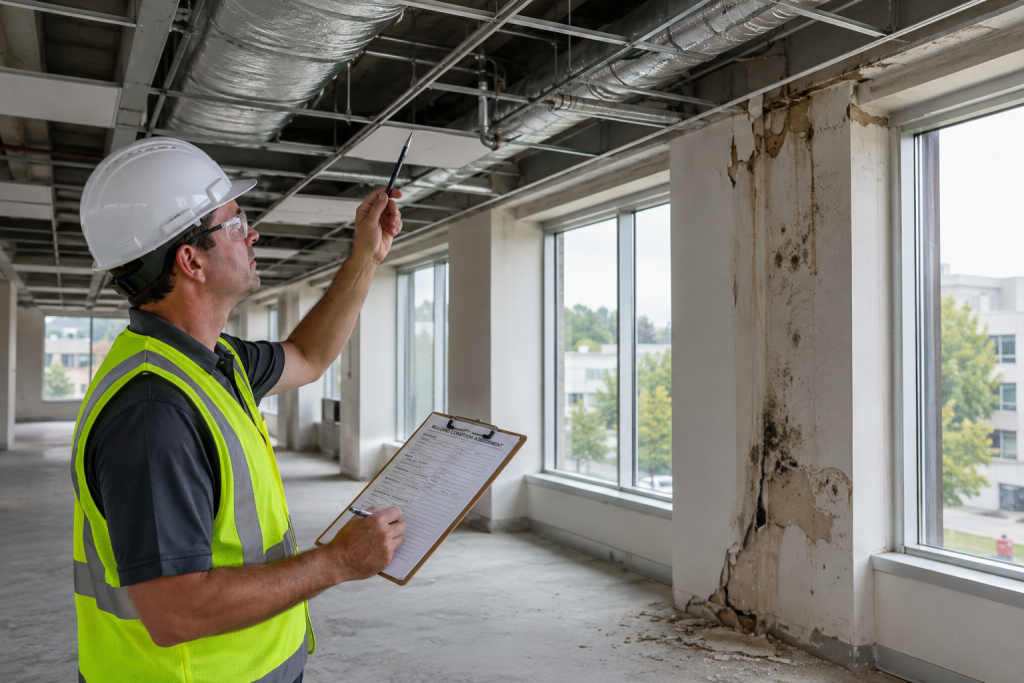
What Does a Building Condition Assessment Cover?
The exact scope varies according to the property and the client’s objectives. A comprehensive assessment may examine the major systems and components that affect the building’s performance, safety, maintenance requirements, and long-term costs.
Structural Components and Building Envelope
An assessment may review observable structural elements for signs of deterioration, damage, movement, cracking, corrosion, or other conditions requiring attention. The building envelope may include exterior walls, windows, doors, sealants, cladding, and other components that protect the interior from weather.
Roofing and Site Conditions
Roofing systems are commonly evaluated for visible deterioration, drainage concerns, membrane or material condition, flashing, and other indicators of maintenance or replacement needs. Depending on the scope, site elements such as paving, drainage, exterior structures, and related improvements may also be considered.
Mechanical, Electrical, and Plumbing Systems
Mechanical systems can include heating, ventilation, and air-conditioning equipment. Electrical reviews may consider distribution equipment, panels, lighting, and other observable components. Plumbing systems can include domestic water, sanitary systems, fixtures, and related equipment.
The assessment may also consider interiors, accessibility-related observations, life-safety components, and other systems relevant to the property’s use. Specialized testing may require separate investigation when a visible condition suggests a deeper problem.
How Does a Building Condition Assessment Work?
Building condition assessments generally begin by establishing the property’s characteristics and the client’s objectives. The assessor then gathers available information, performs the agreed inspection, documents findings, and prepares a report.
1. Review Available Information
Before visiting the property, the assessor may review drawings, previous inspection reports, maintenance records, repair histories, equipment information, and other available documentation. These records can provide useful context and help identify recurring or previously documented concerns.
2. Conduct the Property Inspection
The assessor examines accessible areas and building components within the agreed scope. Observations may include photographs, notes, measurements where appropriate, and descriptions of visible deficiencies.
The goal is not simply to create a list of problems. Experienced assessors consider the condition, apparent cause, significance, and likely maintenance implications of what they observe.
3. Evaluate and Prioritize Findings
Observed deficiencies are reviewed and categorized according to their apparent condition and importance. Some issues may require immediate attention, while others can reasonably be addressed as part of planned maintenance or future capital work.
4. Prepare the Assessment Report
The findings are organized into a report that gives the client a usable record of existing conditions, recommendations, priorities, and potential next steps.
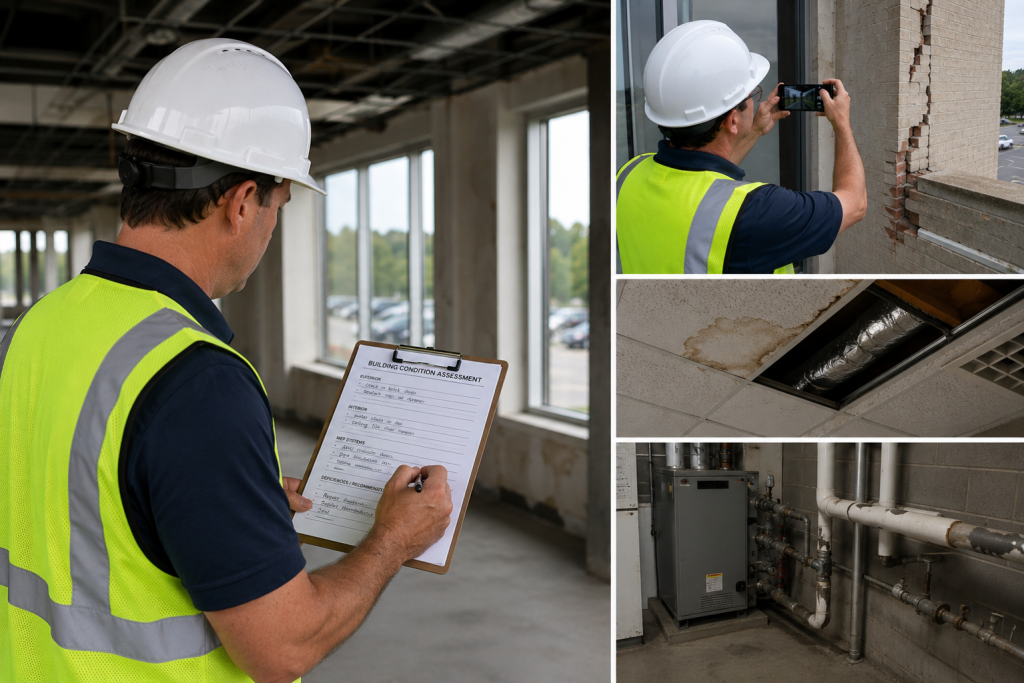
What Is Included in a Building Condition Assessment Report?
A well-prepared report should turn inspection observations into information that a property owner can actually use.
Typical Report Contents
Depending on the agreed scope, a report may include:
- Property and building information
- Description of the assessment methodology and scope
- Summary of significant findings
- Photographs documenting observed conditions
- Condition ratings or classifications
- Identified deficiencies
- Recommended repairs or further investigation
- Repair or replacement priorities
- Estimated costs when included in the scope
- Information about remaining useful life for applicable components
- Limitations and exclusions of the assessment
A strong report should make important findings easy to locate and understand. Instead of burying significant deficiencies in technical language, it should help decision-makers see what needs attention, why it matters, and what action may be appropriate.
How Does a Building Condition Assessment Help Prioritize Repairs and Plan Costs?
One of the most useful outcomes of an assessment is a clearer framework for deciding what should happen next. Not every deficiency deserves the same level of urgency or investment.
Separating Immediate Needs From Future Planning
For instance, a deteriorated component presenting a significant operational or safety concern may warrant prompt action. A component showing moderate deterioration but continuing to perform adequately may instead belong on a planned maintenance or capital replacement schedule.
This distinction helps owners avoid treating every repair as an emergency. It can also support more realistic budgeting by identifying major replacements before they become unexpected expenses.
Supporting Capital Planning
Building condition assessments can provide valuable information for multi-year capital planning. When the condition and approximate remaining service life of major components are understood, owners can begin allocating funds for future repairs and replacements.
For investors, buyers, and property managers, the findings can also provide useful context when evaluating a property’s overall condition and anticipated ownership costs. Where cost estimates are included, they should be understood as planning information rather than guaranteed construction prices.

When Should You Get a Building Condition Assessment?
There is no single schedule that applies to every property. The appropriate timing depends on the building’s age, complexity, use, maintenance history, ownership objectives, and known concerns.
Common Situations That Call for an Assessment
An assessment can be useful when acquiring or evaluating a property, planning significant renovations, developing a capital improvement program, reviewing deferred maintenance, or preparing a long-term facilities strategy.
It may also be appropriate when a building has experienced recurring problems, when major systems are aging, or when ownership needs a current baseline of property conditions.
For larger or more complex properties, periodic building condition assessments can help owners track deterioration and update capital plans as conditions change. The frequency should be determined according to the property’s circumstances rather than relying on a one-size-fits-all interval.
Make Informed Decisions With a Building Condition Assessment
A building condition assessment gives property owners and investors something easy to overlook in the excitement of a deal: clarity. Knowing exactly what you’re working with, down to the wiring, the roof, and the foundation, turns guesswork into a plan, and that plan is often the difference between a property that pays off and one that quietly drains resources for years.
Dwanderful is a real estate investing resource created by real estate investor and podcast host Dwan Bent-Twyford. Since understanding financing is an important part of investing, Dwan offers resources to help investors build their knowledge and make more informed decisions.
Her free Real Estate Lingo book explains essential real estate terms, while Five Pillars of Real Estate Investing provides practical knowledge and strategies for building a strong investing foundation. For investors interested in distressed properties, LEVEL 1: Complete Foreclosure Investors’ Choice Program teaches foreclosure investing strategies, while Foreclosure Fortunes helps investors identify foreclosure opportunities and avoid common pitfalls. The Fed Up Program focuses on helping homeowners in financial distress while creating opportunities for investors.
Dwan also offers How to Sell a House When It’s Worth Less Than the Mortgage, covering options such as short sales and subject-to strategies, and Short-Sale Pre-Foreclosure Investing, which explores buying properties through short-sale and pre-foreclosure opportunities.
If you’re still deciding on your next investment move, Dwanderful’s quiz game takes less than a minute and helps you discover how you could potentially generate six figures in the next six months, whether you’re buying your first property or your next. Contact us now!

Frequently Asked Questions About Building Condition Assessments
How long does a building condition assessment take?
The timeline depends on the size, age, complexity, accessibility, and condition of the property, as well as the assessment’s scope. A smaller building with straightforward systems may require less time than a large commercial property with numerous systems and structures. Report preparation also adds time after the site inspection.
How much does a building condition assessment cost?
There is no universal price. Costs can vary based on building size, location, complexity, number of systems, accessibility, documentation available, and the level of investigation required. The best way to obtain a meaningful price is to provide the assessor with enough information to define the property’s scope and objectives.
Do I need to prepare anything before a building condition assessment?
Providing available drawings, previous reports, maintenance records, repair histories, equipment information, and details about known concerns can help the assessor work more efficiently. Ensuring reasonable access to relevant areas can also make the inspection more productive.
Can a building condition assessment identify hidden problems?
It can identify visible indicators that suggest a concealed problem may exist, but a standard assessment is generally not a guarantee that every hidden defect will be discovered. Specialized testing, destructive investigation, laboratory analysis, or additional professional evaluation may be recommended when conditions warrant further investigation.
Who should perform my building condition assessment?
Choose a qualified professional or firm with relevant experience assessing properties similar to yours. Consider the assessor’s technical expertise, experience with the building type and systems involved, assessment methodology, reporting quality, and ability to clearly explain findings and recommendations. For complex properties, the appropriate assessment team may include professionals with different areas of technical expertise.

Editorial Review by Dwan,
Real Estate Investor & Podcast Host
Dwan is America’s Most Sought After Real Estate Investor™ and The Queen of Short Sales™. She went from a single mom with no resources to building a successful real estate business through wholesaling, rehabbing, rentals, and commercial properties. Today, she teaches investors how to succeed without costly mistakes through her books, podcast, and training programs.
Learn More