


Key Takeaways
- A conventional mortgage is funded by private lenders and isn’t insured by a government agency like the FHA or VA.
- Most lenders want a credit score of at least 620, though the best rates go to borrowers above 740.
- Down payments can start at 3% for qualified first-time buyers, though 20% avoids private mortgage insurance.
- PMI is required below 20% down but can typically be removed once you reach 20% equity.
- Conventional loans work for primary residences, second homes, and investment properties.
- Closing usually takes 30 to 45 days, depending on the lender and your paperwork.
A conventional mortgage is a home loan not backed by the government, usually needing a 620+ credit score, as little as 3% down, and PMI if you put down under 20%.
Buying a home comes with a mountain of unfamiliar terms, and “conventional mortgage” is one you’ll run into almost immediately. It’s the most common type of home loan in the United States, but that doesn’t make it simple. Knowing how it works, what it costs, and who it fits best can save you real money before you ever sign closing documents.
What Is a Conventional Mortgage?
A conventional mortgage is a home loan that isn’t insured or guaranteed by a federal agency. It’s originated by private lenders such as banks, credit unions, and mortgage companies, following guidelines largely set by Fannie Mae and Freddie Mac, the entities that buy most conventional loans on the secondary market.
That’s the key difference from FHA, VA, or USDA loans, which carry government backing that reduces lender risk and opens the door to borrowers with lower credit or smaller down payments. Without that safety net, conventional lenders typically set stricter standards.
Conforming vs. Non-Conforming Loans
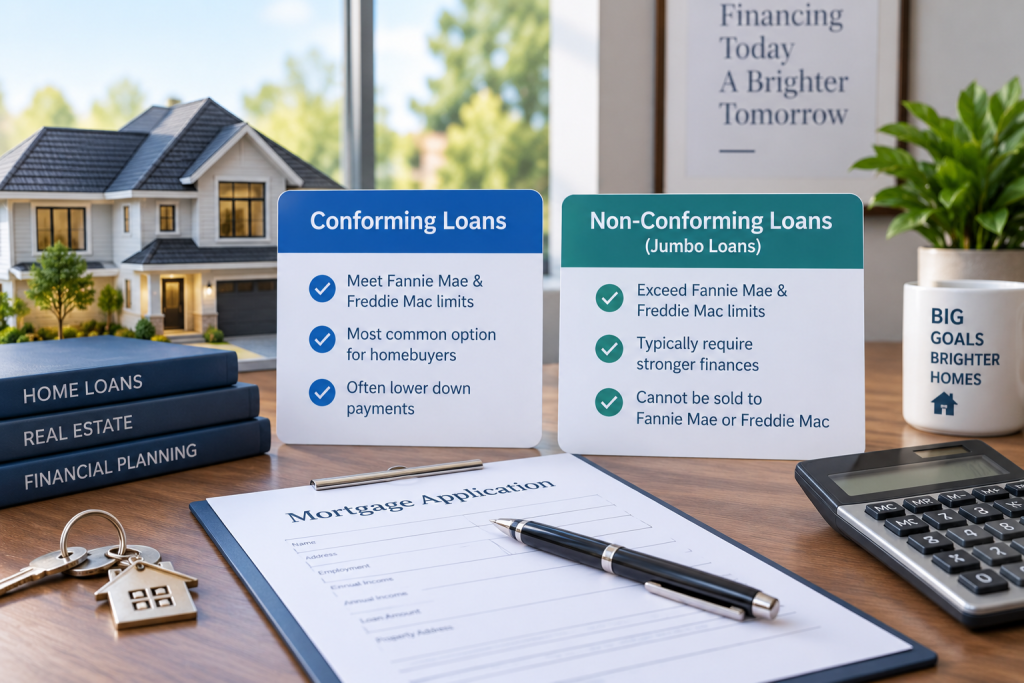
Conforming loans meet Fannie Mae and Freddie Mac’s borrowing limits, which is what most buyers use. Non-conforming loans, often called jumbo loans, exceed those limits and usually require stronger finances, since they can’t be sold to Fannie Mae or Freddie Mac.
How Does a Conventional Mortgage Work?
Once approved, a conventional mortgage works like most home loans. You borrow a set amount, agree to an interest rate, and repay the balance over a fixed term, most commonly 15 or 30 years. Your payment covers principal, interest, and usually property taxes and insurance held in escrow.
Fixed-Rate vs. Adjustable-Rate Options
Borrowers can choose a fixed-rate mortgage, where the rate stays the same for the loan’s life, or an adjustable-rate mortgage (ARM), where the rate is fixed briefly before adjusting with the market. Fixed rates offer predictability, which is why most buyers choose them, while ARMs can suit buyers planning to sell or refinance early.
Lenders review your income, assets, debts, and credit history to set your rate and loan amount. Underwriting tends to be more detailed than government-backed programs, since no federal guarantee cushions the lender’s risk.
What Are the Requirements for a Conventional Mortgage?
Requirements vary by lender, but most conventional mortgages share a similar baseline.
Credit Score
A minimum score of 620 is standard, though some lenders set the bar higher. Scores above 740 typically unlock the most competitive rates, so improving your credit before applying can lower your payment.
Debt-to-Income Ratio
Lenders generally want total monthly debt, including the new mortgage, to stay below 43% to 50% of gross income. A lower ratio can offset a smaller down payment or lighter credit score.
Income, Employment, and Property Standards
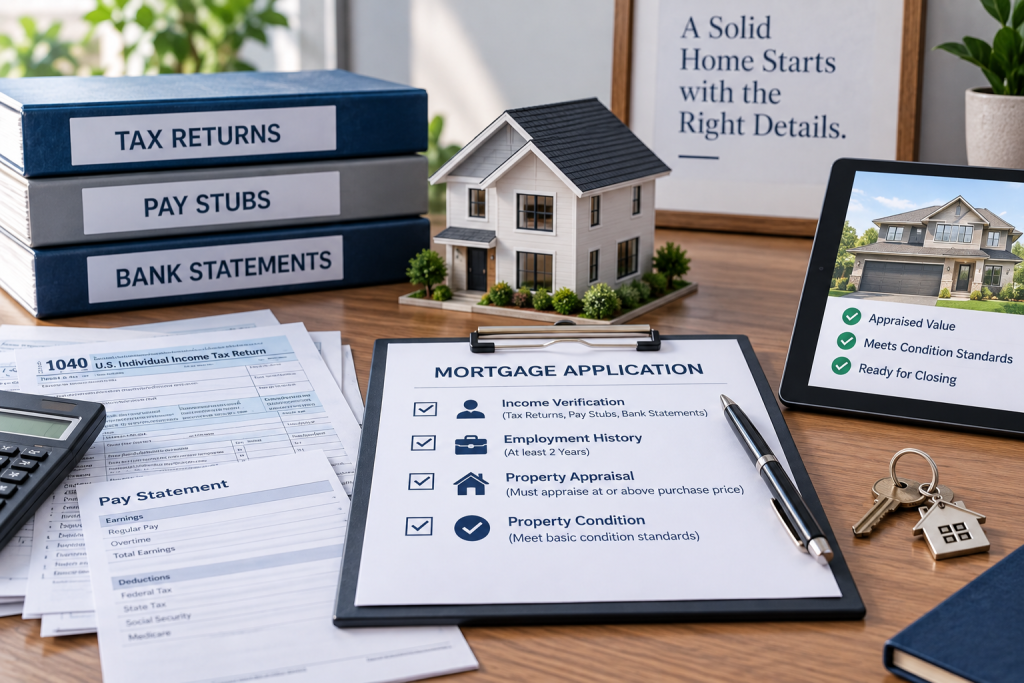
Expect to provide two years of tax returns, pay stubs, and bank statements; self-employed borrowers should prepare extra documentation. The home must also appraise at or above the purchase price and meet basic condition standards, generally less strict than FHA loans.
How Much Do You Need for a Conventional Mortgage Down Payment?
Down payment requirements are one of the biggest misconceptions about conventional mortgages. Many buyers assume 20% is mandatory, but that’s not true.
Minimum Down Payment Options
Qualified first-time buyers can put down as little as 3% on programs like Fannie Mae’s HomeReady or Freddie Mac’s Home Possible. Repeat buyers often need 5%, while second homes or investment properties usually require 10% to 25%.
Why 20% Still Matters
Putting down 20% eliminates private mortgage insurance and often unlocks better rates, since it signals lower risk to the lender. It’s not required, but for buyers who can manage it, it’s usually worth the long-term savings.
What Is PMI and When Can You Remove It?
Private mortgage insurance, or PMI, protects the lender if you default on a loan with less than 20% down. It’s not insurance for you; it’s a cost you carry so the lender can offer a smaller down payment.
How Much PMI Costs
PMI typically runs 0.5% to 1.5% of the loan amount per year, split into monthly payments. On a $300,000 loan, that’s roughly $125 to $375 a month, worth factoring into your budget before choosing a lower down payment.
Removing PMI
By law, lenders must cancel PMI once your balance reaches 78% of the home’s original value, as long as payments are current. You can also request cancellation earlier at 80% equity by contacting your servicer.
What Are the Benefits and Drawbacks of a Conventional Mortgage?
Benefits
Conventional mortgages offer flexibility government-backed loans don’t. They finance primary residences, second homes, and investment properties. PMI can be removed once you build enough equity, unlike FHA mortgage insurance, which often lasts the life of the loan.
Drawbacks
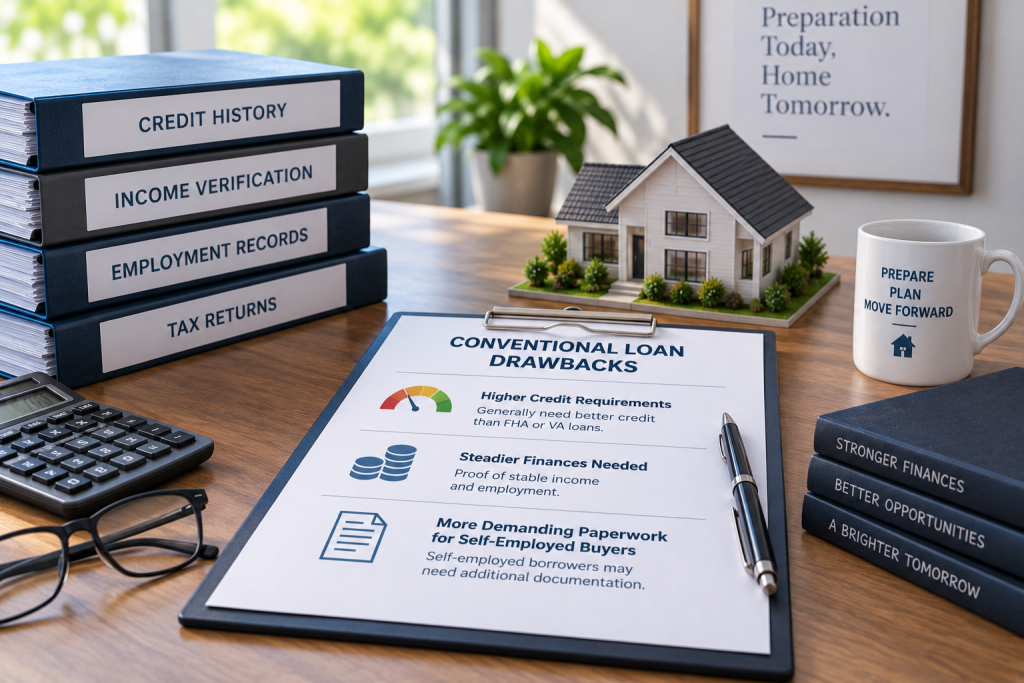
The trade-off is stricter qualifying standards. Borrowers generally need better credit and steadier finances than FHA or VA loans require, and self-employed buyers may find the paperwork more demanding.
How Does a Conventional Mortgage Compare With Other Home Loans?
Compared to an FHA loan, a conventional mortgage demands better credit but can be cheaper long-term since PMI is removable, while FHA mortgage insurance often isn’t. Compared to a VA loan, open only to eligible service members and veterans, conventional loans skip the zero-down option but avoid VA funding fees. Compared to USDA loans, which serve eligible rural properties with no down payment, conventional mortgages offer far more flexibility in location and property type, making them the practical default for most buyers.
Is a Conventional Mortgage Right for You? Let’s Find the Right Financing Option
Choosing the right mortgage depends on your credit, savings, and goals. A conventional loan often fits buyers with steady income and decent credit who want flexibility down the road. But financing is just one piece of building wealth through real estate.
Dwanderful is a real estate investing resource created by real estate investor and podcast host Dwan Bent-Twyford. Since understanding financing is an important part of investing, Dwan offers resources to help investors build their knowledge and make more informed decisions.
Her free Real Estate Lingo book explains essential real estate terms, while Five Pillars of Real Estate Investing provides practical knowledge and strategies for building a strong investing foundation. For investors interested in distressed properties, LEVEL 1: Complete Foreclosure Investors’ Choice Program teaches foreclosure investing strategies, while Foreclosure Fortunes helps investors identify foreclosure opportunities and avoid common pitfalls. The Fed Up Program focuses on helping homeowners in financial distress while creating opportunities for investors.
Dwan also offers How to Sell a House When It’s Worth Less Than the Mortgage, covering options such as short sales and subject-to strategies, and Short-Sale Pre-Foreclosure Investing, which explores buying properties through short-sale and pre-foreclosure opportunities.
If you’re still deciding on your next investment move, Dwanderful’s quiz game takes less than a minute and helps you discover how you could potentially generate six figures in the next six months, whether you’re buying your first property or your next. Contact us now!

Frequently Asked Questions
Can I get a conventional mortgage if I’m a first-time homebuyer?
Yes. Many lenders offer conventional programs for first-time buyers, with down payments as low as 3% and more flexible credit guidelines than most people assume.
Can I use a conventional mortgage to buy a second home or investment property?
Yes. Unlike FHA or VA loans, conventional mortgages can finance second homes and investment properties, though down payment requirements are typically higher.
Can I get a conventional mortgage after bankruptcy or foreclosure?
Often, yes, after a waiting period. Most lenders require four years after a Chapter 7 bankruptcy and seven years after a foreclosure, though shorter timelines may apply with documented extenuating circumstances.
Can I use gift money or down payment assistance toward a conventional mortgage?
Yes. Conventional loans generally allow gift funds from family members and, in many cases, down payment assistance programs, as long as the funds are properly documented.
How long does a conventional mortgage typically take to close?
Most conventional mortgages close in 30 to 45 days from application to closing, though timelines shift based on the lender’s workload, appraisal scheduling, and how quickly you submit documents.

Editorial Review by Dwan,
Real Estate Investor & Podcast Host
Dwan is America’s Most Sought After Real Estate Investor™ and The Queen of Short Sales™. She went from a single mom with no resources to building a successful real estate business through wholesaling, rehabbing, rentals, and commercial properties. Today, she teaches investors how to succeed without costly mistakes through her books, podcast, and training programs.
Learn More