


Key Takeaways
- The 1% Rule in Real Estate is a screening tool, not a guarantee that a rental property will be profitable.
- The basic calculation compares monthly gross rent with the property’s purchase price. A $200,000 property would need about $2,000 in monthly rent to meet the 1% benchmark.
- Investors can use the 1% rule for rental property to quickly compare potential investments and identify properties that deserve deeper analysis.
- Meeting the 1% rule does not account for all expenses, including taxes, insurance, maintenance, vacancy, property management, financing, and capital expenditures.
- A property that falls below 1% can still be a good investment when other factors, such as strong rental demand, favorable financing, appreciation potential, or lower operating costs, support the deal.
- The rule’s usefulness varies by market, so investors should compare properties against local rental prices, expenses, and investment conditions rather than applying the 1% threshold rigidly.
- Before buying, investors should analyze cash flow, cap rate, cash-on-cash return, financing, operating expenses, property condition, and local market conditions.
- The best use of the 1% rule is as a first step in a broader investment analysis, helping investors decide which properties are worth investigating further.
The 1% Rule in Real Estate compares monthly rent with a property’s purchase price to quickly screen rental investments before deeper analysis of costs, cash flow, and risk.
Investors often review several properties before finding one worth pursuing. A listing can look attractive because of its price or expected rent yet produce weak returns after taxes, insurance, repairs, vacancy, financing, and management.
That is where the 1% rule helps. It compares monthly rental income with purchase price, giving investors an early filter before a full deal analysis.
The rule is not a promise of profit. It is a screening tool, and market conditions matter: a property below 1% may still work, while one that reaches 1% can lose money when expenses are high.
What Is the 1% Rule in Real Estate?
If you have searched for “what’s the 1 percent rule in real estate” or “what’s the 1 rule in real estate,” the answer is simple: the 1% rule suggests that a rental property’s monthly gross rent should be at least 1% of its purchase price. For example, a $200,000 property would need approximately $2,000 in monthly rent to meet the benchmark.
What the rule is designed to tell investors
It is useful early in the search process. If comparable properties rent for $1,500 and a house costs $250,000, the ratio is 0.6%. That does not make it a bad investment, but it signals that the deal needs a closer look.
The 1% rule for rental property is therefore best viewed as a quick rent-to-price comparison. Some investors may also consider immediate repair costs when establishing the property’s true acquisition basis, particularly when a low purchase price comes with significant renovation needs.

How to Calculate the 1% Rule for a Rental Property
The basic calculation is:
Monthly Rent ÷ Purchase Price × 100 = 1% Rule
For a $250,000 property expected to rent for $2,500 per month:
$2,500 ÷ $250,000 × 100 = 1%
The property meets the 1% benchmark.
A practical example
Suppose a property costs $180,000 and needs $20,000 in immediate repairs. Comparable homes support $2,000 in monthly rent. Using a $200,000 purchase-plus-repair basis:
$2,000 ÷ $200,000 × 100 = 1%
That is a screening result, not the final decision. Verify achievable rent and estimate expenses, vacancy, financing, and capital needs. Including repair costs can make the initial screen more conservative because the investor is evaluating the amount of capital actually required to acquire and prepare the property.
How Investors Use the 1% Rule to Screen Properties
Investors often use the rule before spending significant time on a full analysis. It can narrow a large list of properties into a smaller group worth researching.
Use the rule as a filter, not a verdict
Verify local rental data using comparable properties with similar locations, sizes, conditions, and amenities. Asking rents are not necessarily rents an owner can consistently collect.
Investigate unusually high rent projections, too. A property may appear to pass because projected rent is optimistic or the price reflects a major repair problem.
The most useful question is not “Does this property pass?” but “Does this property deserve a closer look?” That distinction keeps a simple rule from becoming an overly rigid buying strategy. BiggerPockets likewise describes rules of thumb as quick ways to assess properties before reaching a deeper post-offer analysis.
What the 1% Rule Does Not Account For
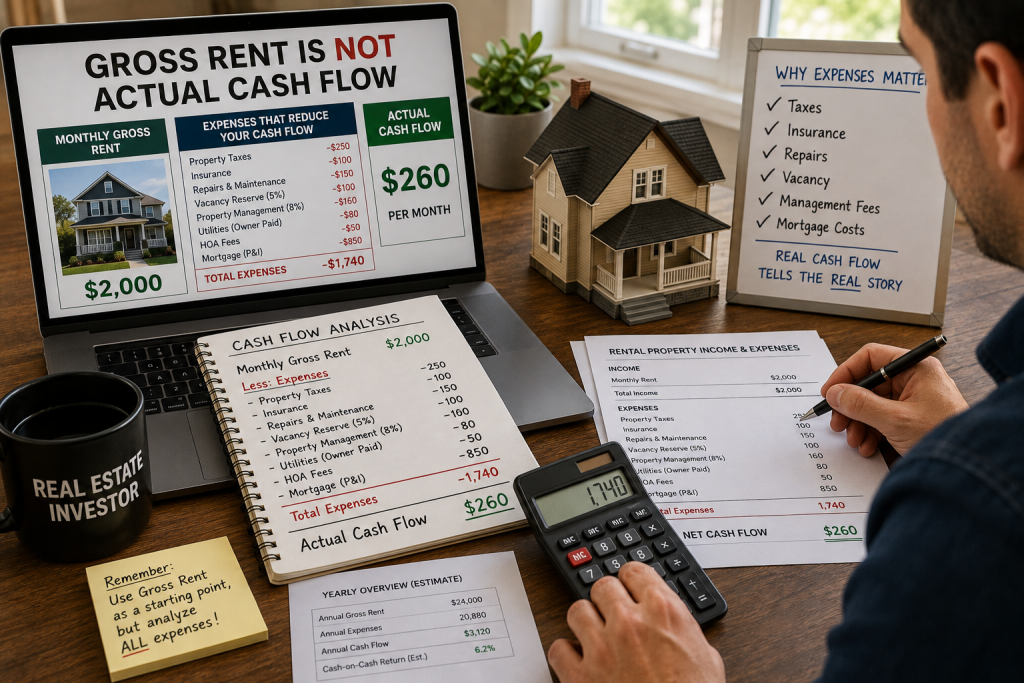
The biggest weakness of the 1% rule is that it focuses on gross rent and price rather than actual cash flow.
Expenses can change the investment picture
Important costs can include:
- Property taxes
- Insurance
- Repairs and maintenance
- Vacancy and turnover
- Property management
- Owner-paid utilities
- Homeowners association fees
- Capital expenditures
- Mortgage interest and financing costs
A property collecting $2,500 in monthly rent does not produce $2,500 in spendable income. Expenses and debt service can reduce the amount available to the investor.
The rule also does not measure appreciation, neighborhood stability, rental demand, property condition, or the investor’s broader goals. Two properties with the same 1% ratio can have very different risk profiles.
Is the 1% Rule Still Relevant in Today’s Real Estate Market?
The 1% rule remains useful, but its relevance depends on the market and investment strategy. In many higher-cost areas, prices have grown faster than rents, making a 1% ratio difficult to achieve.
A property below 1% should not automatically be rejected. A market may have characteristics that make a lower rent-to-price ratio reasonable, including stronger tenant demand or different expectations for appreciation and long-term returns.
Why local market data matters
Instead of treating 1% as a universal pass-or-fail line, compare the ratio across similar properties in the same area.
For example, if comparable rentals consistently produce ratios around 0.6% to 0.8%, a property at 0.8% may deserve more attention than a 1% property with unusually high expenses or weaker tenant demand.
Real estate is local. Performance depends on price, achievable rent, operating costs, financing, condition, and market conditions working together. Current real estate sources similarly caution that the 1% threshold can be difficult to achieve in expensive markets and should be treated as a starting point rather than a guarantee.
What Should Investors Analyze Beyond the 1% Rule?
Once a property passes the initial screen, move into a complete analysis. The goal is to estimate what the property could realistically produce rather than relying on one ratio.
Look at actual cash flow
Estimate vacancy, maintenance, management, taxes, insurance, utilities, recurring costs, and capital needs. Then account for financing and debt service to determine projected cash flow.
Consider other investment metrics
Depending on the strategy, investors may review cap rate, cash-on-cash return, gross rent multiplier, debt service coverage, and projected return on invested capital. No single number should decide the investment.
Also check comparable rents, recent sales, neighborhood trends, condition, and capital expenditures. A strong deal should make sense on paper and in the local market. Rocket Mortgage and BiggerPockets both emphasize using additional analysis rather than relying on the 1% rule alone.
Use the 1% Rule as a Starting Point for Smarter Real Estate Investing
The 1% rule remains a practical way to screen rental properties quickly, but experienced investors know that a screening rule is only the beginning. Strong investment decisions combine simple benchmarks with verified market data, realistic expenses, financing assumptions, and a clear understanding of risk.
Dwanderful is a real estate investing resource created by real estate investor and podcast host Dwan Bent-Twyford. Since understanding financing is an important part of investing, Dwan offers resources to help investors build their knowledge and make more informed decisions.
Her free Real Estate Lingo book explains essential real estate terms, while Five Pillars of Real Estate Investing provides practical knowledge and strategies for building a strong investing foundation. For investors interested in distressed properties, LEVEL 1: Complete Foreclosure Investors’ Choice Program teaches foreclosure investing strategies, while Foreclosure Fortunes helps investors identify foreclosure opportunities and avoid common pitfalls. The Fed Up Program focuses on helping homeowners in financial distress while creating opportunities for investors.
Dwan also offers How to Sell a House When It’s Worth Less Than the Mortgage, covering options such as short sales and subject-to strategies, and Short-Sale Pre-Foreclosure Investing, which explores buying properties through short-sale and pre-foreclosure opportunities.
If you’re still deciding on your next investment move, Dwanderful’s quiz game takes less than a minute and helps you discover how you could potentially generate six figures in the next six months, whether you’re buying your first property or your next. Contact us now!

Frequently Asked Questions About the 1% Rule
Can a property still be a good investment if it does not meet the 1% rule?
Yes. A property can still make sense when its ratio is below 1% if other factors support the investment, such as strong appreciation potential, reliable tenants, lower expenses, favorable financing, or a compelling purchase price. The 1% rule is a screening guideline, not a universal requirement.
What percentage should I look for if a rental property does not meet the 1% rule?
There is no single percentage for every market or strategy. Compare the ratio with similar rentals and analyze projected cash flow. A local benchmark can be more useful than forcing every property to reach 1%.
Does the 1% rule apply to multifamily properties?
Yes. Investors can use the same rent-to-price concept when screening duplexes, triplexes, fourplexes, and other rentals. Also account for unit-level rents, vacancy, operating expenses, utilities, repairs, and property-specific costs.
Can I use the 1% rule when buying an investment property with a mortgage?
Yes, but the calculation does not replace financing analysis. Mortgage interest, principal, loan terms, taxes, insurance, and other costs can materially affect cash flow. A property can meet 1% and still produce weak returns after debt service.
How close to the 1% rule should a rental property be before I consider it?
There is no universal cutoff. A property at 0.8% may deserve serious consideration in one market, while a 1% property may be unattractive in another. Use the ratio to decide whether to investigate further, then evaluate the complete deal.

Editorial Review by Dwan,
Real Estate Investor & Podcast Host
Dwan is America’s Most Sought After Real Estate Investor™ and The Queen of Short Sales™. She went from a single mom with no resources to building a successful real estate business through wholesaling, rehabbing, rentals, and commercial properties. Today, she teaches investors how to succeed without costly mistakes through her books, podcast, and training programs.
Learn More