


Key Takeaways
- Commercial property loans provide financing to purchase, build, improve, or refinance business and investment real estate.
- Loan options vary by purpose and borrower, including traditional commercial loans, SBA financing, bridge loans, construction loans, and commercial real estate lines of credit.
- Lenders evaluate more than credit scores. They may review the property’s value and income, the borrower’s financial strength, cash flow, debt obligations, and experience.
- DSCR and LTV are important lending metrics. DSCR measures whether available cash flow can cover debt payments, while LTV compares the loan amount with the property’s value.
- The total cost goes beyond the interest rate. Borrowers should account for origination fees, appraisal and legal costs, closing expenses, and possible prepayment penalties.
- Commercial loans can have different terms and structures. A loan may have a shorter maturity than its amortization period, potentially leaving a balloon balance at maturity.
- Preparation can improve the loan process. Financial statements, tax returns, property records, leases, rent rolls, and other documents may be required during underwriting.
- The best loan is not necessarily the largest or cheapest. The right financing should fit the property’s cash flow, the borrower’s financial position, investment strategy, and ability to manage repayment risk.
Commercial property loans finance business real estate purchases, construction, improvements, or refinancing, with approval based on the property, borrower, and repayment ability.
Buying commercial real estate is rarely as simple as finding a property and applying for a mortgage. The financing has to make sense for the business, property, and lender, making it important to understand how do commercial property loans work before committing capital.
Unlike a typical residential mortgage, commercial real estate financing is often evaluated as a business transaction. Lenders may look at property income, operating expenses, projected cash flow, the borrower’s financial strength, and property value. Requirements vary by lender, property type, loan purpose, and market conditions.
What Is a Commercial Property Loan and How Does It Work?
A commercial property loan is financing used to acquire, build, improve, or refinance real estate used for business or investment purposes. Examples include office buildings, retail centers, warehouses, industrial facilities, apartment properties, and owner-occupied business buildings.
The basic process is straightforward: a lender provides capital, the borrower uses it for an approved purpose, and the loan is repaid under agreed terms. The property commonly serves as collateral, giving the lender an interest in the real estate if the borrower defaults.
For example, on a $1 million property, a lender requiring 25% equity would finance $750,000 while the buyer contributes $250,000. The actual structure depends on the lender, property, borrower, and loan program.
Types of Commercial Real Estate Loans (SBA, Traditional, Bridge & More)
There is no single commercial loan for every transaction. The right option depends on what you are buying, how the property will be used, and how quickly you need financing.
Traditional Commercial Real Estate Loans
Traditional loans are commonly offered by banks and other lenders for purchases or refinancing. They can work well for established borrowers with strong financials and properties that meet the lender’s standards.
SBA Loans
SBA financing can help qualifying small businesses acquire or improve eligible real estate. SBA 7(a) can finance or refinance real estate and buildings, while SBA 504 can support the purchase or construction of certain owner-occupied facilities. Each program has specific eligibility rules.
Bridge and Other Commercial Loans
Bridge loans provide short-term financing when a borrower needs to move quickly or expects to replace the loan later with longer-term financing. Other types of commercial loans include construction financing, commercial real estate lines of credit, and refinancing loans. Investment and owner-occupied properties can also be underwritten differently.

What Do Lenders Look for When Approving a Commercial Property Loan?
Lenders want evidence that the proposed loan can be repaid without putting the borrower or property under unreasonable financial pressure. Commercial real estate underwriting considers both the transaction and the risks associated with the property and borrower.
Borrower Financial Strength
Expect to provide business financial statements, tax returns, bank statements, debt information, and ownership details. Lenders may also consider the experience of the people operating the business or managing the property.
Property Performance and Value
For income-producing property, lenders may examine rent rolls, leases, operating expenses, occupancy, and net operating income. An appraisal helps establish an independent view of property value.
DSCR and LTV
DSCR, or debt service coverage ratio, compares cash flow available for debt service with required debt payments. In simple terms, it asks whether the property generates enough income to cover the loan.
LTV, or loan-to-value ratio, compares the loan amount with property value. A $700,000 loan on a $1 million property has a 70% LTV. A lower LTV generally means more borrower equity and less lender risk.
Credit, Collateral, and Guarantees
Personal and business credit history may matter, particularly for smaller businesses. Depending on the transaction, lenders may also require additional collateral or a personal guarantee. These requirements are deal-specific, not universal.
How Much Do Commercial Property Loans Cost?
The cost is more than the interest rate. Borrowers should consider the entire financing package.
Common costs can include interest, origination or underwriting fees, appraisal charges, legal expenses, environmental or property reports, title-related costs, and closing expenses. Some loans may also include prepayment penalties or other conditions affecting the total cost.
Rates vary based on the lender, loan structure, borrower qualifications, property type, LTV, market conditions, and whether the rate is fixed or variable. Quoting one “typical” rate without date and loan assumptions can therefore be misleading.
What Are the Typical Terms for Commercial Property Loans?
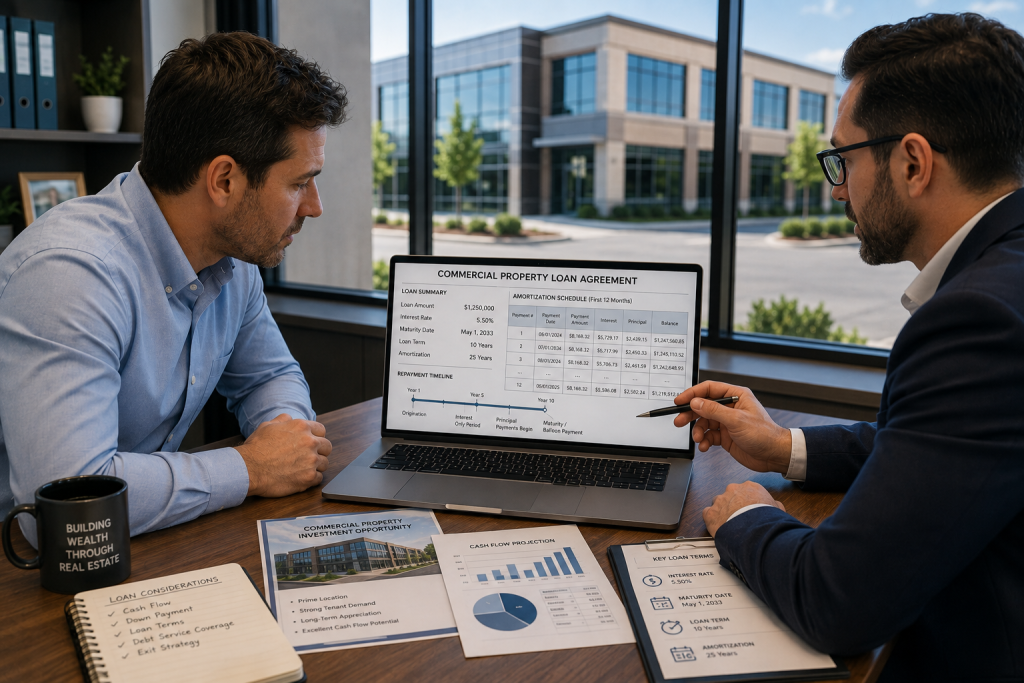
Commercial loan terms vary considerably. A lender may offer a multi-year maturity with a longer amortization period, meaning payments are calculated over a longer period than the loan’s actual maturity. Some loans may therefore have a balloon balance due at maturity.
The structure may include fixed or variable interest, scheduled principal payments, reserve requirements, covenants, or other conditions. SBA financing has its own rules; for example, applicable SBA 7(a) real estate financing can have maturities of up to 25 years, while SBA 504 offers 10-, 20-, and 25-year maturity options.
Step-by-Step: How to Apply and Get Approved
1. Define the Financing Need
Determine whether you are buying, refinancing, constructing, renovating, or improving a property. Know the purchase price, intended use, expected income, expenses, and available cash.
2. Review Your Financial Position
Check business revenue, cash reserves, existing debt, credit history, and available equity before approaching lenders.
3. Prepare Documentation
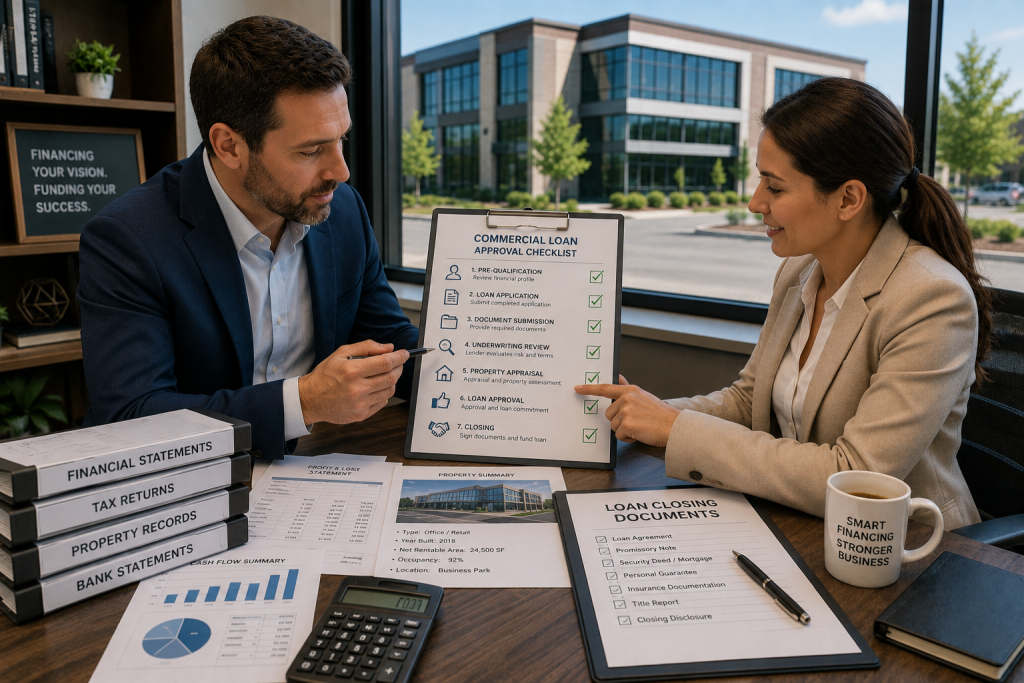
Depending on the transaction, lenders may request tax returns, financial statements, bank statements, leases, rent rolls, purchase agreements, property details, and business projections.
4. Compare Lenders and Structures
Ask about rates, fees, LTV limits, DSCR requirements, guarantees, amortization, maturity, and prepayment provisions.
5. Complete Underwriting and Due Diligence
The lender may verify financial information, order an appraisal, review the property, and evaluate transaction risks.
6. Review and Close
Do not focus only on approval. Make sure the payment, maturity date, fees, covenants, and repayment obligations fit your investment plan. Once conditions are satisfied and documents are signed, the loan can close and funds can be released under the agreement.
Take Control of Your Real Estate Future with Commercial Loans
Commercial property loans can help investors purchase, build, improve, or refinance business real estate, but choosing the right financing requires understanding loan types, costs, terms, lender requirements, and repayment risks.
For investors looking to strengthen their real estate knowledge, Dwanderful is a real estate investing resource created by investor and podcast host Dwan Bent-Twyford. Her free Real Estate Lingo book explains essential real estate terminology, while Five Pillars of Real Estate Investing provides practical knowledge and strategies for building a strong investing foundation. Investors interested in distressed properties can also explore LEVEL 1: Complete Foreclosure Investors’ Choice Program, Foreclosure Fortunes, and the Fed Up Program, which cover foreclosure strategies, identifying opportunities, and helping homeowners in financial distress.
Dwan also offers How to Sell a House When It’s Worth Less Than the Mortgage, covering options such as short sales and subject-to strategies, and Short-Sale Pre-Foreclosure Investing, which explores short-sale and pre-foreclosure opportunities.
If you’re still deciding on your next investment move, Dwanderful’s quiz game takes less than a minute and helps you discover how you could potentially generate six figures in the next six months, whether you’re buying your first property or your next. Through these resources, Dwan’s experience can help investors build their knowledge and approach their next real estate opportunity with greater confidence. Contact us now!

Frequently Asked Questions About Commercial Property Loans
Can I get a commercial property loan if my business is new?
Possibly. A new business may have less operating history, so a lender could place greater weight on the owner’s financial strength, experience, available equity, collateral, projected cash flow, and property fundamentals. SBA financing also has specific eligibility requirements.
Can I use a commercial property loan to refinance an existing property?
Yes. Refinancing can replace an existing loan, change the repayment structure, access equity when permitted, or potentially improve financing terms. Whether it makes sense depends on costs, the existing loan, property value, cash flow, and the new loan’s terms.
Do I need to personally guarantee a commercial property loan?
Not always, but personal guarantees are common in some commercial lending situations, particularly for smaller businesses or closely held companies. Requirements depend on the lender, borrower, property, and transaction. Review the guarantee carefully before signing.
Can I pay off a commercial property loan early?
Sometimes, but early repayment may trigger a prepayment penalty or other fee. The loan agreement controls. Ask about prepayment provisions before closing, especially if you expect to sell or refinance before maturity.
What happens if I cannot make my commercial property loan payments?
Contact the lender as early as possible. Depending on the circumstances, the lender may discuss a workout, modification, refinance, or another solution. If the loan defaults, the lender may have rights against the collateral and, where applicable, a guarantor. Consequences depend on the contract and applicable law.

Editorial Review by Dwan,
Real Estate Investor & Podcast Host
Dwan is America’s Most Sought After Real Estate Investor™ and The Queen of Short Sales™. She went from a single mom with no resources to building a successful real estate business through wholesaling, rehabbing, rentals, and commercial properties. Today, she teaches investors how to succeed without costly mistakes through her books, podcast, and training programs.
Learn More