


Investing in commercial real estate can generate substantial returns, but only when deals are analyzed carefully before making a purchase. Successful investors don’t rely on intuition alone—they use data, financial metrics, and market research to determine whether a property is worth pursuing.
Learning how to analyze a commercial real estate deal like a pro can help you identify profitable opportunities, reduce risk, and make informed investment decisions. Whether you’re evaluating an office building, retail center, industrial property, or multifamily complex, following a structured process is essential.
Understanding the Property and Market Fundamentals
Before reviewing the numbers, investors should evaluate the property’s location, asset type, and market conditions. Strong commercial properties are often located in areas with growing populations, expanding businesses, and increasing demand for commercial space.
It’s also important to understand local economic trends, vacancy rates, and future development projects. Investors new to the industry can benefit from learning more about commercial real estate investing before analyzing potential opportunities.
Review Income, Expenses, and Net Operating Income
A property’s income potential is one of the most important factors in determining its value. Start by examining rent rolls, lease agreements, occupancy rates, and historical income statements. This information helps investors understand how much revenue the property currently generates.
Next, review operating expenses such as taxes, insurance, maintenance, utilities, and management fees. Subtracting operating expenses from gross income provides the Net Operating Income (NOI), which serves as a key indicator of investment performance and profitability.
Calculate Key Commercial Real Estate Metrics

Professional investors rely on financial metrics to evaluate deals objectively. One of the most commonly used metrics is the cap rate, which measures a property’s expected return based on its income and purchase price.
Understanding metrics such as cash-on-cash return, debt service coverage ratio (DSCR), and internal rate of return (IRR) can provide deeper insights into a property’s potential. For a better understanding of this concept, review our guide on commercial property cap rates.
Evaluate Property Value and Financing Options
Determining whether a property is priced correctly requires comparing it to similar commercial properties in the area. Investors often review comparable sales, replacement costs, and income-based valuation methods to estimate a property’s fair market value.
Financing also plays a critical role in overall returns. Loan terms, interest rates, amortization schedules, and down payment requirements can significantly impact cash flow and profitability. Learn more about commercial property valuation and financing commercial property before making an investment decision.
Commercial Real Estate Deal Analysis Checklist
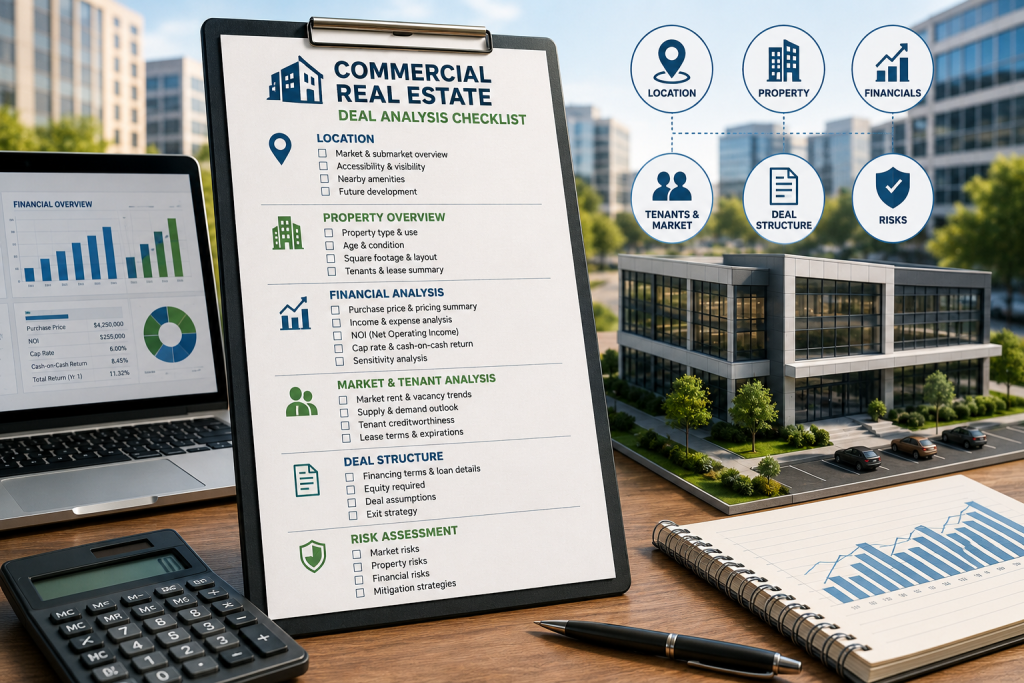
Before moving forward with any commercial property acquisition, investors should complete a thorough due diligence review. A structured evaluation process helps uncover hidden risks and ensures all critical factors are considered.
When analyzing a commercial real estate deal, make sure to:
- Verify rental income and occupancy rates to confirm the property’s current revenue performance.
- Review all lease agreements to understand tenant obligations, lease lengths, and renewal options.
- Calculate Net Operating Income (NOI) to measure the property’s operational profitability.
- Determine the cap rate and compare it with similar properties in the market.
- Evaluate financing costs including interest rates, loan terms, and debt obligations.
- Analyze local market trends such as employment growth, population changes, and commercial demand.
- Inspect the physical condition of the property to identify maintenance issues or future repair costs.
- Assess tenant quality and stability to reduce vacancy and income risks.
- Review zoning regulations and legal requirements that may affect future use or redevelopment.
- Estimate future appreciation potential based on market conditions and development plans.
- Compare the property against alternative investment opportunities to ensure the best use of capital.
- Conduct a comprehensive risk assessment before finalizing the purchase.
By following this systematic approach, investors can identify stronger opportunities, avoid costly mistakes, and make more confident investment decisions. The most successful commercial real estate investors consistently rely on data-driven analysis rather than assumptions when evaluating deals.
FAQs
1. What is the first step in analyzing a commercial real estate deal?
The first step is evaluating the property’s location, market conditions, and income potential.
2. What metrics should investors use to evaluate a commercial property?
Lower rates reduce financing expenses and improve monthly cash flow.
3. Why is Net Operating Income (NOI) important?
NOI helps determine a property’s profitability by subtracting operating expenses from gross income.
4. How does financing impact a commercial real estate deal?
Loan terms, interest rates, and down payment requirements directly affect cash flow and returns.
5. What risks should investors consider before purchasing a commercial property?
Common risks include vacancies, declining market conditions, maintenance costs, and tenant turnover.